If you check into a normal hotel, the front desk usually handles your accommodation registration when it scans your passport. If you stay in a friend’s home, a private apartment, or another non-hotel address, you or the person hosting you must deal with it directly.
First decide whether the property is acting as a hotel
- Licensed hotel: present the original passport at reception and ask the hotel to register the stay.
- Friend or relative’s home: the visitor or host should complete non-hotel accommodation registration.
- Private apartment or short-term rental: do not assume the booking platform handled it. Ask the host exactly who will register, through which official channel, and when.
- University or organization housing: the institution may file on the visitor’s behalf, but confirm and keep proof.
A booking receipt is not the same as police accommodation registration.
Where to register
The established offline route is the local police station, police office, or foreigner service station responsible for the address. The correct office depends on the property’s location, not whichever police station is easiest to find on a map.
From March 20, 2026, the National Immigration Administration began an online pilot for non-hotel accommodation in Hebei, Liaoning, Zhejiang, Hubei, Guangxi, Chongqing, and Sichuan. The official channels include the NIA government website, NIA 12367 app, and NIA 12367 mini programs. The offline route remains available, and the pilot is not the same as nationwide online availability.
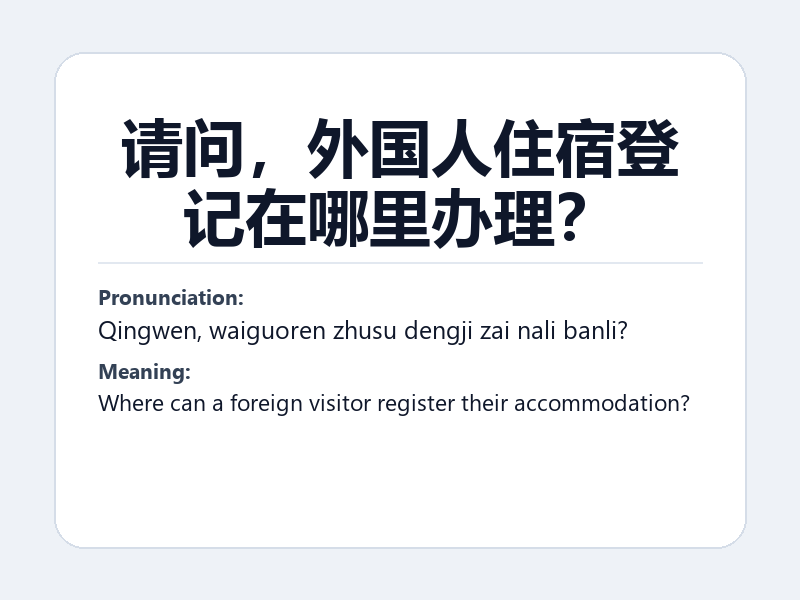
请问,外国人住宿登记在哪里办理?
Pronunciation: Qingwen, waiguoren zhusu dengji zai nali banli?
Where can a foreign visitor register their accommodation?
What to prepare
Local requirements can differ, but prepare more than the passport alone:
- The visitor’s original passport and current visa, entry stamp, or stay document.
- The exact address in Chinese, including building, unit, and room number.
- The host’s identification and contact details.
- Proof that the host owns, rents, or lawfully controls the property, if requested.
- The rental agreement or booking record for a private apartment.
- Arrival date and the intended length of stay.
- Any previous accommodation registration if you have moved.
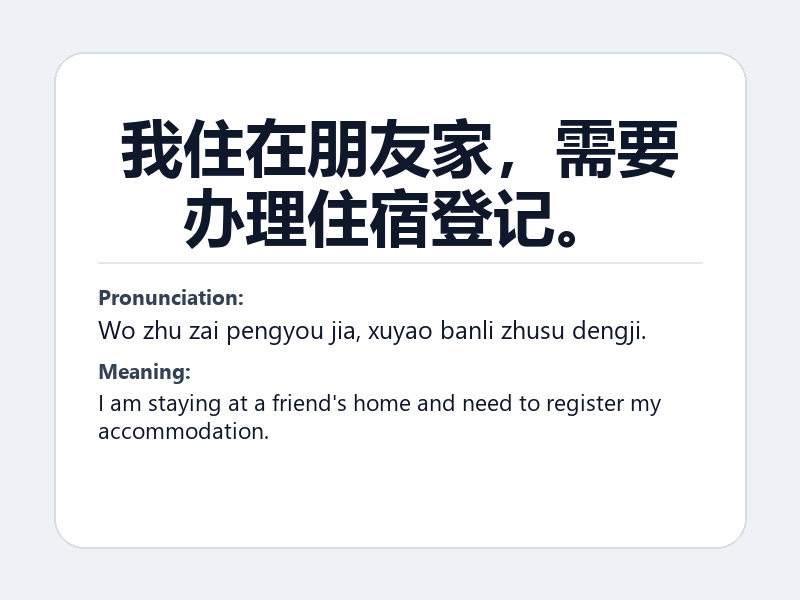
我住在朋友家,需要办理住宿登记。
Pronunciation: Wo zhu zai pengyou jia, xuyao banli zhusu dengji.
I am staying at a friend’s home and need to register my accommodation.
Call before making a wasted trip
Ask the host to contact the police station responsible for the address and confirm its registration hours and document list. A neighborhood may use a service station that is not obvious in an English map search. The NIA service hotline is 12367 inside China.
What happens during registration
- Provide the visitor, host, and address information.
- Show the requested identity and property documents.
- Check the spelling of the passport name and number.
- Confirm the arrival date and address.
- Keep the paper receipt, screenshot, or online confirmation.
Photograph the confirmation and send a copy to the host. It may be useful later for visa, residence, police, or administrative procedures.
If you move
Registration belongs to the place where you are staying. When you move from a hotel to a friend’s apartment, or from one private address to another, treat the new address as a new accommodation event. Ask the local authority how quickly the new registration must be completed; the statutory rule is within 24 hours after arrival at the accommodation.
If a short-term rental host says registration is unnecessary
Ask a concrete question: “Will you register my passport with the local public security authority, or should we go to the police station?” If the host cannot explain the process before arrival, that is a reason to reconsider the booking. This is more important than a vague promise that “foreigners stay here all the time.”
If you are already late
Do not solve lateness by continuing to ignore the rule. Contact the responsible police station or 12367, explain the actual arrival date, bring the documents, and follow the instruction given. The NIA states that failure to register can lead to a warning and a fine of up to RMB 2,000.
FAQ
Does an Airbnb-style platform register me?
Do not assume so. China does not use one universal platform process. Confirm the legal accommodation and registration arrangement with the host before booking.
Does my friend need to come with me?
Requirements vary. The host’s identity and property documents may be needed, so ask the responsible station before going alone.
Do I need to register for one night?
The rule is based on staying outside a hotel, not on reaching a minimum number of nights.
What if the hotel says it cannot accept foreigners?
Government guidance has told accommodation operators not to refuse overseas visitors simply because they lack foreign-guest capability. Ask the hotel to contact its system provider or local authority, and keep a backup booking if staff cannot resolve it.
Registration rules and the current online pilot
- NIA: accommodation registration rules for foreigners
- NIA: 2026 online registration pilot for non-hotel accommodation
- Official guide to residence registration and accommodation
For hotel stays: read the foreign-guest hotel check-in guide.