For a first high-speed train, I would aim to reach the correct station about an hour before departure. That is not a railway guarantee or a universal requirement. It is a practical buffer for a traveler who still needs to find the entrance, pass security, use a foreign passport lane, read the departure board, and locate a gate inside a very large building.
Work backward from departure
- Departure time: the train leaves; it is not the time to reach the platform.
- Gate closing: follow the station display and announcement because the cutoff varies.
- Gate opening: many trains board only shortly before departure, so a closed gate may simply mean boarding has not started.
- Waiting hall: allow time to find the gate number after security.
- Station entrance: add passport checks, baggage screening, and the walk from your drop-off point.
My buffer for different situations
About an hour is sensible for a first visit to a major station. Add more time during public holidays, with children, large luggage, mobility needs, an unverified passport, or a station you have never seen. A regular traveler with no luggage may use less; copying that person’s timing is not a good first-trip strategy.
At the station
- Keep the original passport used for booking in your hand before the entrance.
- Put bags through security and follow instructions about drinks or restricted items.
- Find the train number on the board, then confirm departure time and gate.
- Wait near the correct gate without blocking the queue.
- When boarding starts, use the staffed passport lane if the automatic gate does not read the document.
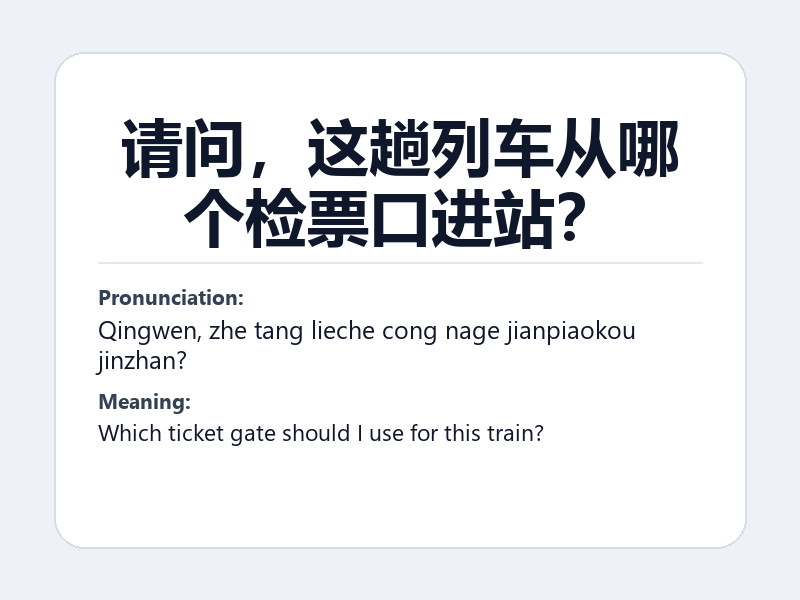
请问,这趟列车从哪个检票口进站?
Pronunciation: Qingwen, zhe tang lieche cong nage jianpiaokou jinzhan?
Which ticket gate should I use for this train?
If the board has not assigned a gate
Stay in the waiting hall and watch the train number, not only the destination. Several trains can leave for the same city. If departure is approaching and no gate appears, ask staff with the ticket screen open.
Quiet mistakes to avoid
- Going to the station with the same city name but a different direction word.
- Looking for a paper ticket when the passport is the e-ticket credential.
- Waiting at a gate for the right destination but the wrong train number.
- Putting the passport in a checked bag or a suitcase buried under other luggage.
- Buying food after boarding has begun.
FAQ
Is 30 minutes enough?
It can be, until traffic, the entrance, or passport scanning takes ten minutes longer than expected. I would not plan a first trip around the minimum.
Can I enter very early?
Station access rules and waiting capacity vary. An hour or two is usually more useful than arriving half a day early.
Do I need to collect a paper ticket?
Normally the passport linked to the e-ticket is used for travel. An itinerary or reimbursement receipt is not the boarding credential.
Official information to check
Check first: make sure you are going to the correct station.