City buses are useful when the metro does not reach your destination, but the hard part is not paying. It is choosing the correct side of the road and knowing when to get off. Before boarding, save the Chinese name of the destination, the route number, direction and stop count.
Confirm the direction before the bus arrives
- Open the route in Amap (高德地图, Gaode Ditu) or another map that shows live transit.
- Compare the route number on the map with the number on the physical stop sign.
- Find the terminal name after “toward” or the arrow. The same route number runs in two directions.
- Count how many stops remain and note one major stop before yours.
- Screenshot the destination stop in Chinese in case the map reloads.
Ways to pay
Payment varies by city and route. Common options include a local transport QR code in Alipay, a transit card and exact cash. Some buses require scanning both when boarding and leaving; others charge a flat fare only when boarding. Watch what passengers do and read the instruction beside the scanner.
- Open the transport QR code before the bus arrives.
- Increase screen brightness.
- Do not scan a merchant payment code unless the driver or sign clearly directs you to it.
- If using cash, prepare small notes or coins; drivers generally do not make change.
Track the journey without relying on announcements
Keep the map open and watch the bus move along the route. GPS can lag, so use three signals together: current location, stop count and the Chinese stop name displayed inside the bus. Move toward the door after the stop before yours.
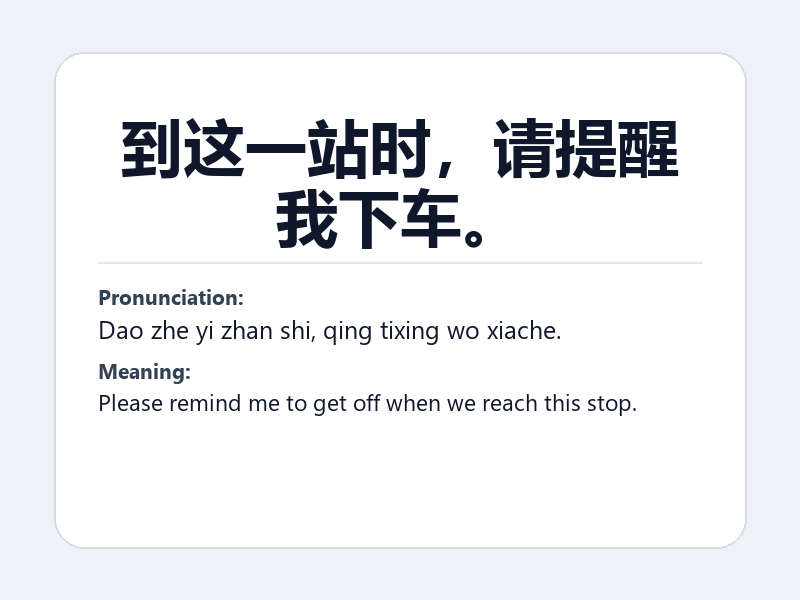
到这一站时,请提醒我下车。
Pronunciation: Dao zhe yi zhan shi, qing tixing wo xiache.
Please remind me to get off when we reach this stop.
Getting off
Some buses stop at every station; others may require a stop button. Press it once after leaving the previous stop if nobody else is preparing to exit. If the route uses distance-based QR fares, scan again at the exit as instructed.
If you miss the stop
Do not ask the driver to stop in traffic. Get off at the next legal stop, move away from the road, and recalculate. Crossing a wide road or expressway on foot may be impossible, so the safest correction could be another bus or a short DiDi ride.
FAQ
Does every bus display English stop names?
No. Major cities and central routes are more likely to provide English, but you should keep the Chinese stop name available.
Can I take luggage?
Ordinary luggage is usually possible if you can control it without blocking doors or aisles. For a large suitcase during rush hour, the metro or a car may be more practical.
Why did the driver wave me away from the front door?
Boarding and exit doors vary. Follow the arrows and other passengers rather than forcing the door.
Official information to check
For rail travel inside cities, use the metro guide.