First move: choose a restaurant with visible prices and photos, use a camera translation app on the menu, order a few simple dishes first, confirm spice level and allergies before ordering, and pay with Alipay (支付宝, Zhifubao), WeChat Pay (微信支付, Weixin Zhifu), card, or cash depending on what the restaurant accepts.
Ordering food in China gets much easier once you know the flow. The first time is where people get stuck: the menu may be Chinese-only, the ordering may happen through a QR code, the waiter may expect quick decisions, and the food names may not translate cleanly. What matters is this: eat safely, understand the price, and avoid ordering something wildly different from what you expected.
What should you prepare before going out?
- A camera translation app. Google Translate, Apple Translate or iPhone text recognition, Microsoft Translator, Pleco, Baidu Translate (百度翻译, Baidu Fanyi), and Youdao Translate (有道翻译, Youdao Fanyi) can all be useful in different situations.
- Offline language packs if your app supports them. Google says camera translation can work offline for downloaded languages. Do not assume your network will be perfect inside every restaurant.
- Your food restrictions written in Chinese. Allergies, vegetarian needs, religious restrictions, and spice limits should be saved as text and screenshots.
- At least two payment options. Alipay (支付宝, Zhifubao), WeChat Pay (微信支付, Weixin Zhifu), card, and cash do not work equally everywhere.
- Your hotel address saved. If the meal goes late or the restaurant is hard to find again, you still need to get back.
Which restaurant should you choose for your first meal?
For the first meal, boring is good. Look for:
- Prices shown clearly. Menus, wall boards, QR menus, or printed prices are better than verbal-only pricing.
- Photos of dishes. Photos reduce translation mistakes.
- Local customers eating normally. A busy mall restaurant, food court, noodle shop, or chain can be easier than a tourist-area restaurant with someone pulling you in.
- A simple ordering process. Counter ordering, table QR ordering, or a paper menu with photos is easiest.
- Reasonable distance from your hotel. Your first meal is not the time to cross the city for a viral restaurant.
Price warning: avoid places where prices are unclear, seafood is marked as “market price,” or staff push you to order before you understand the menu. For more detail, read restaurants with posted prices.
How do Chinese restaurants usually work?
- Counter ordering: you order and pay first, then pick up food or wait for it to be brought over.
- Table service: you sit down, order with a waiter or QR code, eat, then pay after the meal.
- QR code ordering: scan a table QR code with WeChat (微信, Weixin), Alipay (支付宝, Zhifubao), or sometimes the phone camera. The menu may open as a mini program.
- Food courts: you may order from different stalls. Some accept direct payment; some use a shared payment system.
- Hotpot or barbecue: you order raw ingredients and cook them yourself. This is fun, but not always the easiest first meal if you are tired.
How do you use camera translation on a Chinese menu?
- Take a photo first. A still photo is often easier to translate than waving the camera over a glossy menu.
- Translate small sections, not the whole menu at once. Dish names can be poetic. A full-page translation can become nonsense.
- Use the original Chinese characters to confirm. If the translation says “fish fragrant eggplant,” that does not mean fish is in the dish; it may be a sauce style.
- Look for ingredients and cooking method. Meat, vegetable, noodle, rice, soup, spicy, fried, steamed, grilled.
- Check the price column. Make sure you understand whether the price is per dish, per portion, per person, per 500g, or market price.
- If the translation looks strange, order from photos or ask for a recommendation. Do not over-trust one weird translation.
Useful menu words to recognize
- 菜单 (caidan): menu.
- 扫码点餐 (saoma diancan): scan code to order.
- 招牌 (zhaopai): signature dish.
- 套餐 (taocan): set meal or combo.
- 米饭 (mifan): rice. It is not always automatically included.
- 面 (mian): noodles.
- 牛肉 (niurou): beef.
- 猪肉 (zhurou): pork.
- 鸡肉 (jirou): chicken.
- 羊肉 (yangrou): lamb or mutton.
- 鱼 (yu): fish.
- 虾 (xia): shrimp.
- 蔬菜 (shucai): vegetables.
- 汤 (tang): soup.
- 辣 (la): spicy.
- 微辣 (wei la): mildly spicy.
- 不辣 (bu la): not spicy.
- 麻辣 (ma la): numbing and spicy.
- 清淡 (qingdan): lighter, less oily, less strong.
- 时价 (shijia): market price. Be careful if you do not know the approximate price.
What should you order first?
If you are unsure, start with a simple order:
- One carb: rice, noodles, dumplings, fried rice, or a set meal.
- One protein: chicken, beef, pork, fish, tofu, or eggs.
- One vegetable dish. This helps balance the meal and is usually easy to share.
- One safe drink. Bottled water, tea, or a sealed drink is easier than asking for tap water or ice water.
In many Chinese restaurants, dishes are shared. You do not always order one “main course” per person like in some Western restaurants. A group may order several dishes for the table plus rice or noodles.
Need a dedicated guide? Read vegetarian ordering in China and food allergy cards for China.
How do you handle spice, allergies, and diet restrictions?
- Spice: say 不辣 (bu la, not spicy) or 微辣 (wei la, mildly spicy). But some restaurants still treat “mild” as fairly spicy.
- Vegetarian: vegetarian does not always mean no meat stock, no lard, or no tiny meat pieces. Be specific.
- Allergies: do not rely on a casual verbal request. Show a written Chinese allergy note and choose simpler dishes.
- Religious restrictions: write the restriction in Chinese and avoid restaurants where the cuisine makes it hard to control ingredients.
- Severe allergies: be conservative. Cross-contamination can be difficult to explain in a busy restaurant.
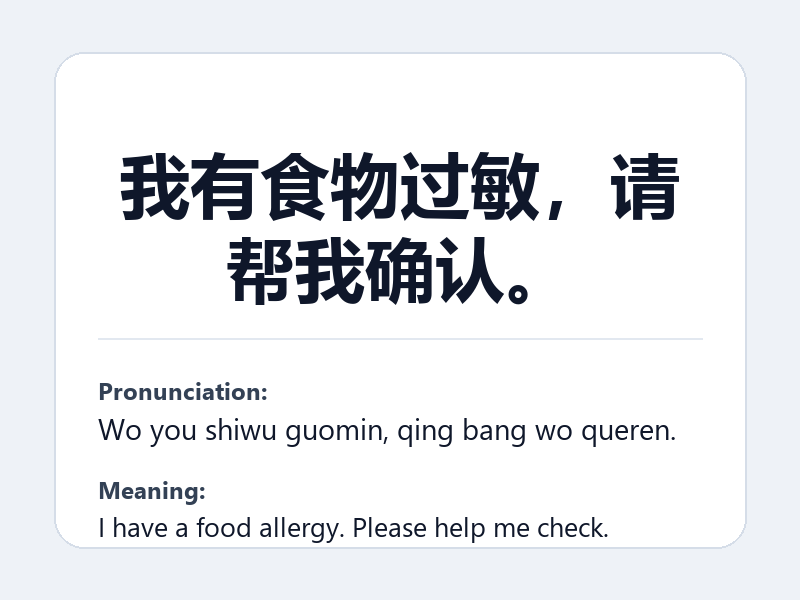
Allergy warning: the phrase card below says you have a food allergy and need help checking. It is not enough for a severe allergy by itself. Prepare a specific Chinese allergy card before travel.
What should you know about restaurant etiquette?
- No tipping is normally expected. In most ordinary restaurants, you do not need to tip.
- Sharing dishes is normal. Do not be surprised if dishes arrive in the middle of the table.
- Serving chopsticks may be provided. Use them if they are there, especially in a group meal.
- Do not stick chopsticks upright in rice. It has funeral associations and looks very awkward.
- Do not dig through a shared dish. Take from the portion near you.
- Tea or hot water may appear automatically. In some places it is free; in some places tea or tableware may have a small charge.
- Napkins may not be on the table. Bring tissues. This sounds small until you need them.
- It is okay to ask for a spoon or fork. Not every restaurant has forks, but many mall restaurants and hotel-area restaurants do.
How do you pay?
- QR payment is common. Alipay (支付宝, Zhifubao) and WeChat Pay (微信支付, Weixin Zhifu) are widely used.
- Some places ask you to pay at the cashier. The waiter may point to the front counter.
- Some QR ordering systems ask you to pay before the kitchen prepares the food. That is normal in many casual restaurants.
- Cards may not work everywhere. International cards are not a safe only option for small restaurants.
- Cash may work, but change can be annoying. Keep small notes if you plan to use cash.
What should you say?
Save the phrase cards you may need before you go out. If the waiter is busy, show the card instead of explaining slowly in English.
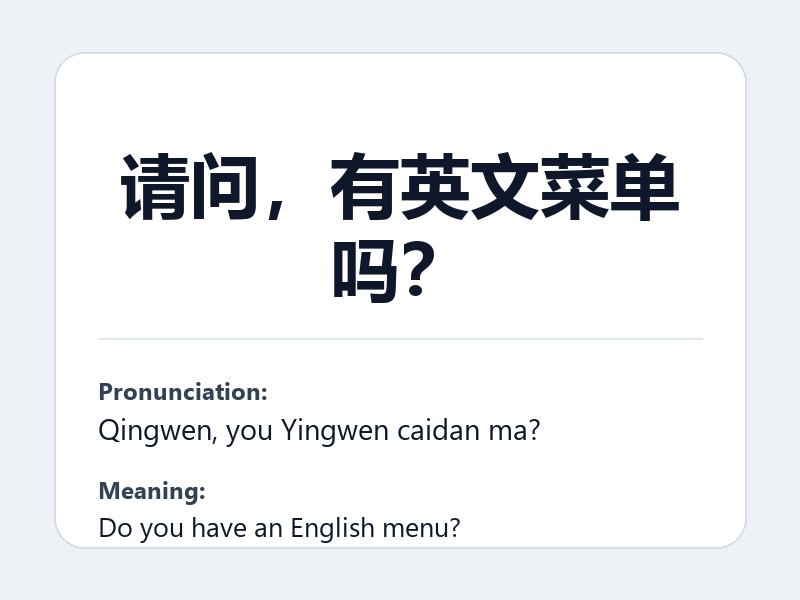
- 请问,有英文菜单吗? (Qingwen, you Yingwen caidan ma?)
Do you have an English menu?
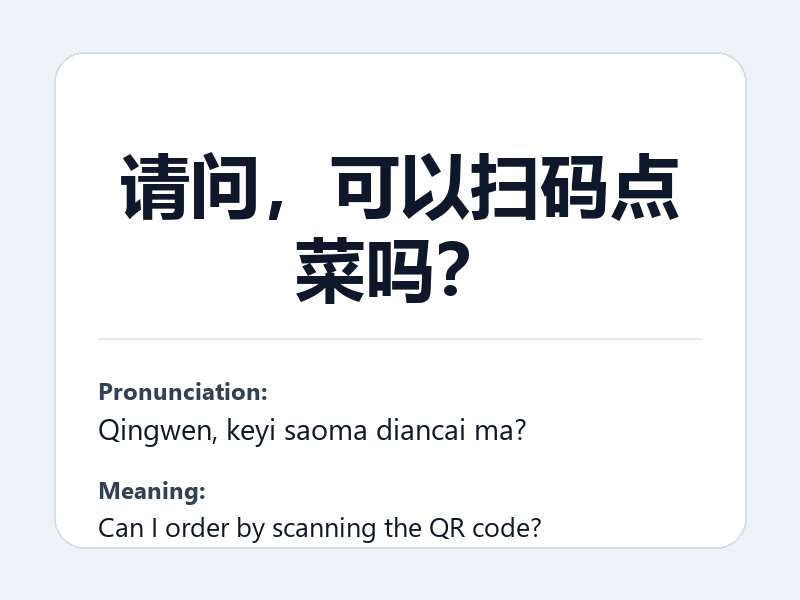
Save this phrase card before you go out. - 请问,可以扫码点菜吗? (Qingwen, keyi saoma diancai ma?)
Can I order by scanning the QR code?
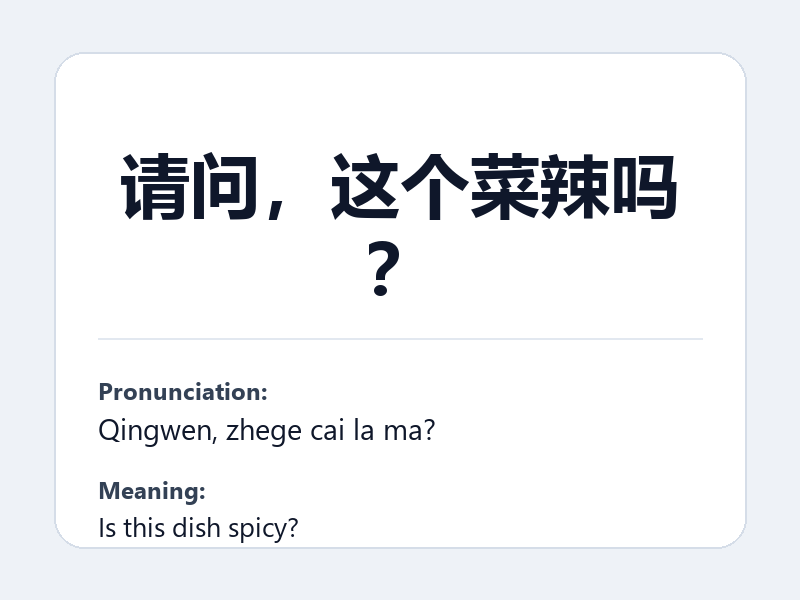
Save this phrase card before you go out. - 请问,这个菜辣吗? (Qingwen, zhege cai la ma?)
Is this dish spicy?
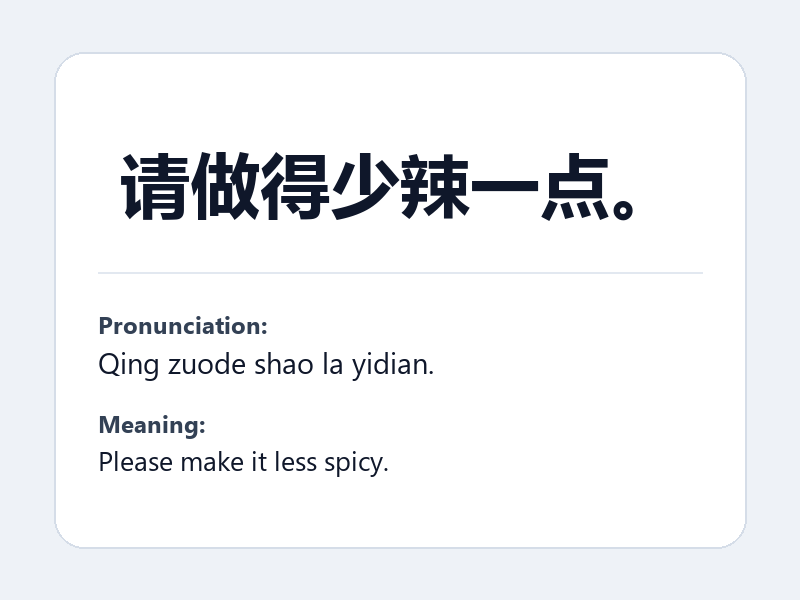
Save this phrase card before you go out. - 请做得少辣一点。 (Qing zuode shao la yidian.)
Please make it less spicy.
Save this phrase card before you go out. - 我有食物过敏,请帮我确认。 (Wo you shiwu guomin, qing bang wo queren.)
I have a food allergy. Please help me check.
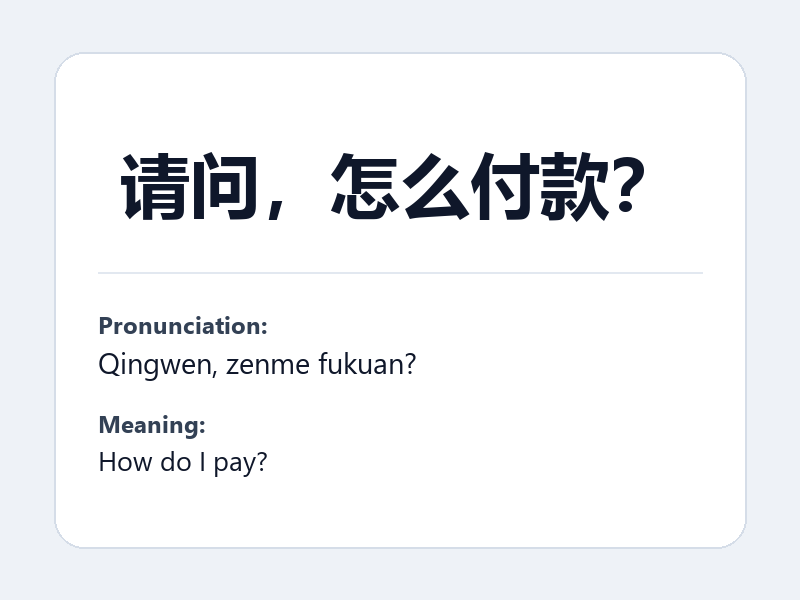
Save this phrase card before you go out. - 请问,怎么付款? (Qingwen, zenme fukuan?)
How do I pay?
Save this phrase card before you go out.
Common first-restaurant mistakes
- Ordering too much. Chinese shared dishes can be larger than expected.
- Assuming rice comes automatically. Ask for rice if you want it.
- Trusting a poetic dish translation too literally. Use photos and ingredient words.
- Not checking spice level. Some “mild” dishes are still spicy for visitors.
- Ignoring market price seafood. Ask for the price before ordering anything marked 时价.
- Going to the restaurant someone aggressively recommends outside a tourist spot. Check prices and reviews first.
FAQ
Can I just point at pictures?
Yes. Pointing at photos is a perfectly practical first-meal strategy. If the dish has options, the waiter may still ask about size, spice, rice/noodles, or meat type.
What if the QR code menu is Chinese-only?
Use camera translation on another phone if possible, or ask for a paper menu. If the mini program blocks translation, take screenshots and translate the screenshots.
What if I scan the QR code but cannot pay?
Ask whether you can order with the waiter or pay at the cashier. If your mobile payment fails, try the other wallet, card, or cash. For more detail, read the mobile payment failure guide.
Can I ask for food to be packed?
Yes. Say 打包 (dabao, pack it to go). Many restaurants can pack leftovers, though packaging may cost a small fee.
Is tap water served in restaurants?
Usually do not expect cold tap water like in some countries. Hot water, tea, bottled water, or purchased drinks are more common. If unsure, order bottled water.
Is it rude to finish everything?
No. In ordinary restaurant meals, eating normally and not wasting too much food is fine. At a formal hosted meal, local customs can be more complicated, but this site is mainly for practical travel situations.
What if I accidentally order something I cannot eat?
Stay polite, explain the problem, and ask whether it can be changed. If the dish has already been cooked correctly according to your order, the restaurant may still charge you.