What to do first: vegetarian food is possible in China, but you need to be specific. 素食 (sushi) can still be misunderstood, and some vegetable dishes may use meat stock, oyster sauce, shrimp paste, lard, or tiny pieces of meat. Show a clear Chinese card before ordering.
China has plenty of vegetables, tofu, noodles, rice, mushrooms, and Buddhist-style vegetarian food. Finding vegetables is not the hard part. The hard part is making sure the kitchen understands exactly what you do not eat.
What should you say first?
Save these cards before you go out. If you are strict vegetarian or vegan, show the more specific card.
- 我是素食主义者。请问这里有素食吗? (Wo shi sushizhuyizhe. Qingwen, zheli you sushi ma?)
I am vegetarian. Do you have vegetarian food here?
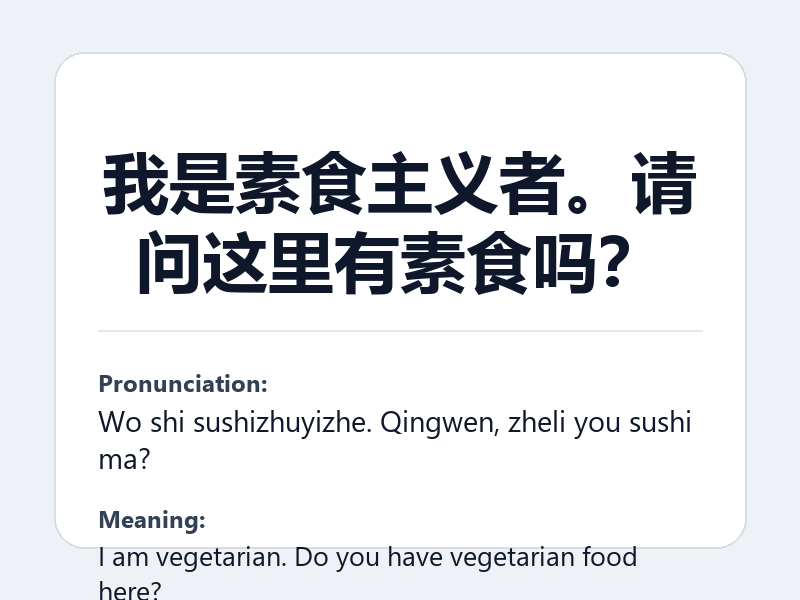
Save this phrase card before you go out. - 我是纯素食者。请不要放肉、蛋、奶。 (Wo shi chun sushizhe. Qing buyao fang rou, dan, nai.)
I am vegan. Please do not add meat, eggs, or dairy.
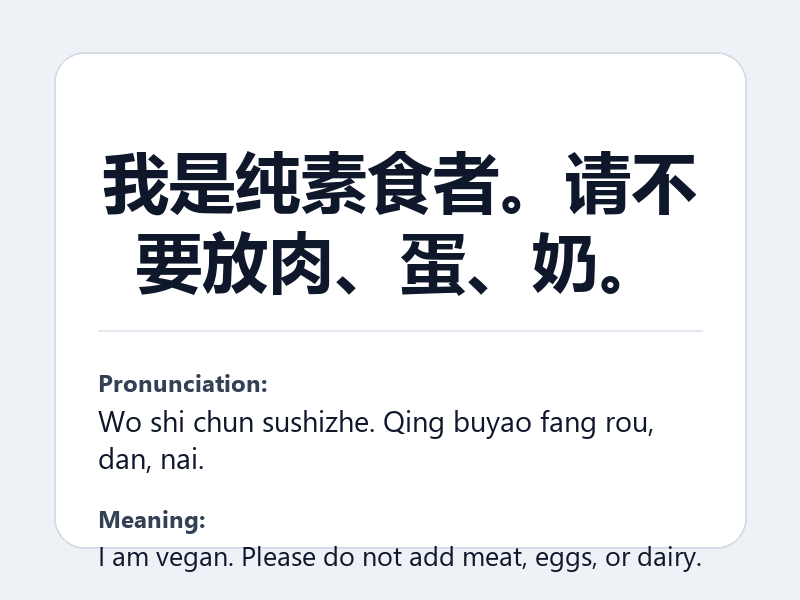
Save this phrase card before you go out. - 请不要放肉、海鲜或动物油。 (Qing buyao fang rou, haixian huo dongwuyou.)
Please do not add meat, seafood, or animal fat.
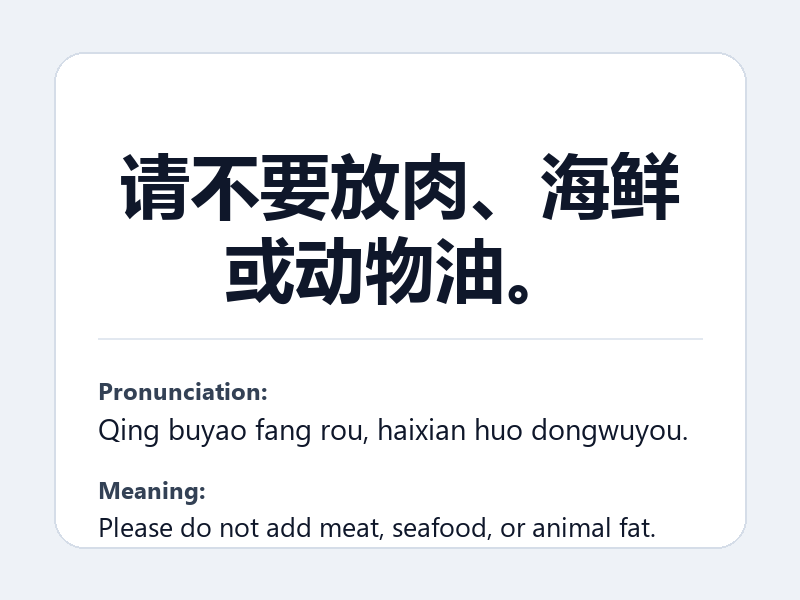
Save this phrase card before you go out.
Why can vegetarian ordering be confusing in China?
- Vegetable dishes may still use meat flavor. Meat stock, chicken powder, oyster sauce, shrimp skin, dried seafood, or lard can appear even when the dish looks vegetarian.
- 素 (su) may mean different levels of strictness. Some people understand it as no visible meat. Others understand it as Buddhist vegetarian. You need to say what you avoid.
- Eggs and dairy are separate questions. If you are vegan, say no meat, no seafood, no eggs, no dairy, and no animal fat.
- Mock meat is not always vegan. Some vegetarian restaurants use eggs, milk, or additives.
Best restaurant choices
- Dedicated vegetarian restaurants: search for 素食餐厅 (sushi canting) or 素斋 (suzhai).
- Buddhist-style vegetarian restaurants: often safer for meat-free food, but still ask about egg/dairy if vegan.
- Simple noodle or rice shops: easier if you can choose tomato egg noodles, plain vegetable noodles, mushroom dishes, tofu, or greens. Vegan travelers still need to ask about stock and egg.
- Mall restaurants with photos and QR menus: easier to translate and check ingredients.
Foods that often work, with checks
- Mapo tofu: usually contains minced meat unless you ask for no meat. Not a safe default.
- Tomato egg noodles or rice: vegetarian for many people, but not vegan.
- Stir-fried greens: ask whether they use lard, oyster sauce, or meat stock.
- Buddha’s delight / mixed vegetables: often safer, but still check sauce.
- Plain rice, steamed buns, and noodles: may be safe basics, but sauces and fillings matter.
Useful words
- 素食 (sushi): vegetarian food.
- 素食主义者 (sushizhuyizhe): vegetarian.
- 纯素 (chunsu): vegan.
- 肉 (rou): meat.
- 海鲜 (haixian): seafood.
- 鸡蛋 (jidan): egg.
- 牛奶 (niunai): milk.
- 动物油 (dongwuyou): animal fat.
- 猪油 (zhuyou): lard.
- 蚝油 (haoyou): oyster sauce.
Ordering strategy
- Choose a restaurant with visible photos and prices. This reduces confusion.
- Show your card before ordering. Do not wait until after the dish arrives.
- Ask about hidden ingredients. Meat stock, oyster sauce, and lard are the usual traps.
- Order a simple first dish. Tofu, mushrooms, greens, tomato egg, or plain noodles are easier than complex regional dishes.
- If the staff seem unsure, choose another dish or another restaurant. Do not force a complicated request in a busy kitchen.
FAQ
Is China hard for vegetarians?
It can be very manageable in big cities and Buddhist-style vegetarian restaurants. It is harder in small restaurants where meat stock, oyster sauce, or lard are treated as normal seasoning.
Is China hard for vegans?
Vegan ordering is harder than vegetarian ordering. You need to mention eggs, milk/dairy, seafood, and animal fat, not only meat.
Can I just say “no meat”?
That is a useful start, but it may not cover broth, oyster sauce, shrimp skin, lard, or eggs. Use the card if the restriction matters.
What should I do if I am very strict?
Choose dedicated vegetarian restaurants, Buddhist vegetarian restaurants, or restaurants where ingredients are easier to control. Keep the request simple and be willing to leave if staff are unsure.