Keep it simple: if you have a food allergy in China, prepare a Chinese allergy card before you eat out. For severe allergies, do not rely only on machine translation or a casual verbal request. Choose simpler restaurants, avoid unclear sauces and shared kitchens, and do not eat if the staff cannot confirm.
Food allergies are harder than ordinary preference translation. A waiter may understand the word, but a busy kitchen may still use the ingredient in sauce, stock, garnish, oil, or shared cooking equipment. Use this page as a communication guide, not as medical advice. Follow your doctor’s plan and carry any medicine your doctor has prescribed.
Prepare before you go out
- Save a specific Chinese allergy card. Do not only write “I have allergies.” Name the exact food.
- Save the blank card below. Fill in your own allergen in Chinese and English if your allergy is not one of the common cards.
- Choose simpler food. Sauces, soups, hotpot broths, dumpling fillings, desserts, and fried foods are harder to verify.
- Tell the restaurant before ordering. Do not wait until the food arrives.
- Know emergency options. If you have a severe allergy, keep your medicine accessible and know how to ask for medical help.
Blank allergy card
Use this card when your specific allergen is not listed below. Fill the blank with the Chinese name of your allergen before going out.
- 我对以下食物过敏:____。请不要放这种食材。 (Wo dui yixia shiwu guomin. Qing buyao fang zhezhong shicai.)
I am allergic to this food. Please do not add this ingredient.
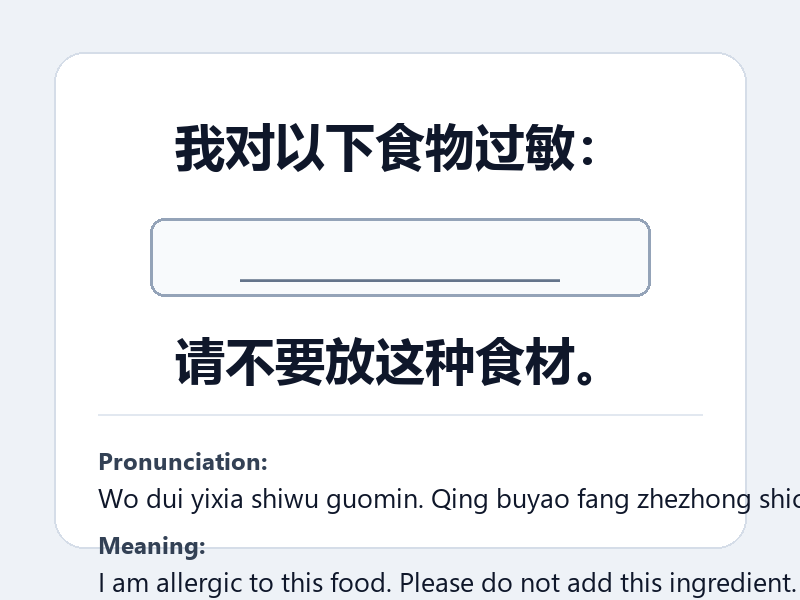
Fill in your own allergen before you save this card.
Common allergy phrase cards
Save the card that matches your allergy. If your allergy is severe, still explain that cross-contact is dangerous and choose the restaurant carefully.
- 我对花生过敏,请不要放花生。 (Wo dui huasheng guomin, qing buyao fang huasheng.)
I am allergic to peanuts. Please do not add peanuts.
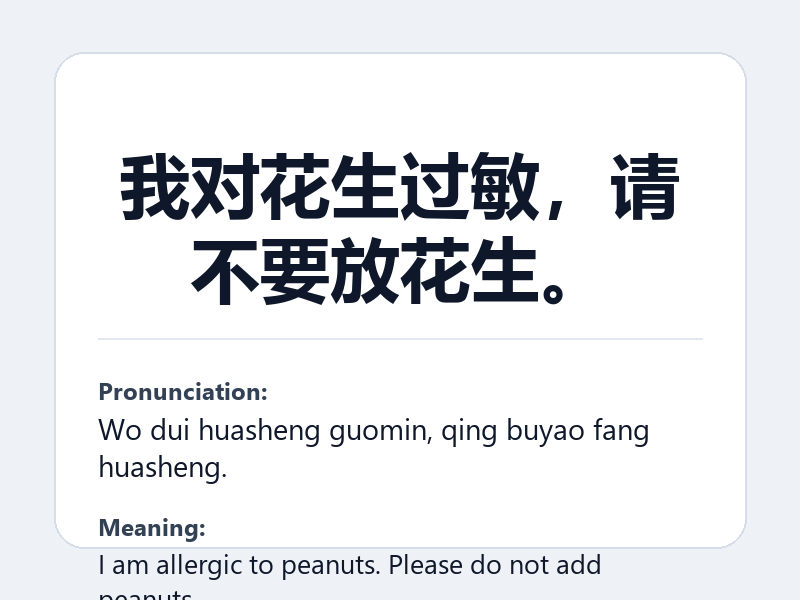
Save this phrase card before you go out. - 我对坚果过敏,请不要放坚果。 (Wo dui jianguo guomin, qing buyao fang jianguo.)
I am allergic to tree nuts. Please do not add nuts.
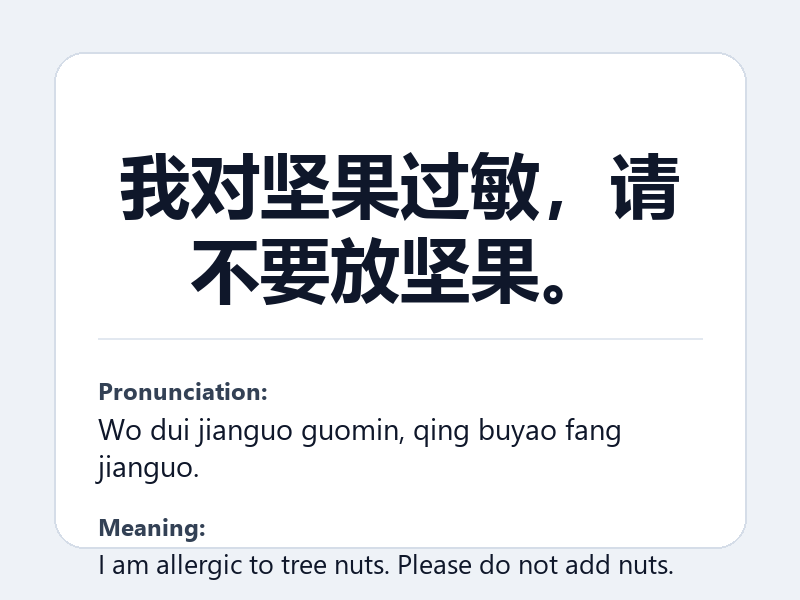
Save this phrase card before you go out. - 我对虾、蟹、贝类过敏,请帮我确认。 (Wo dui xia, xie, beilei guomin, qing bang wo queren.)
I am allergic to shrimp, crab, and shellfish. Please help me check.
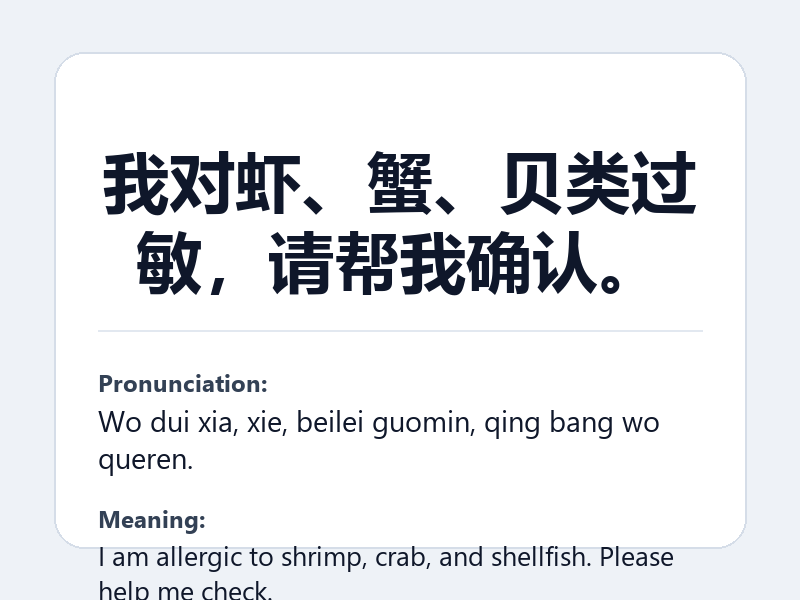
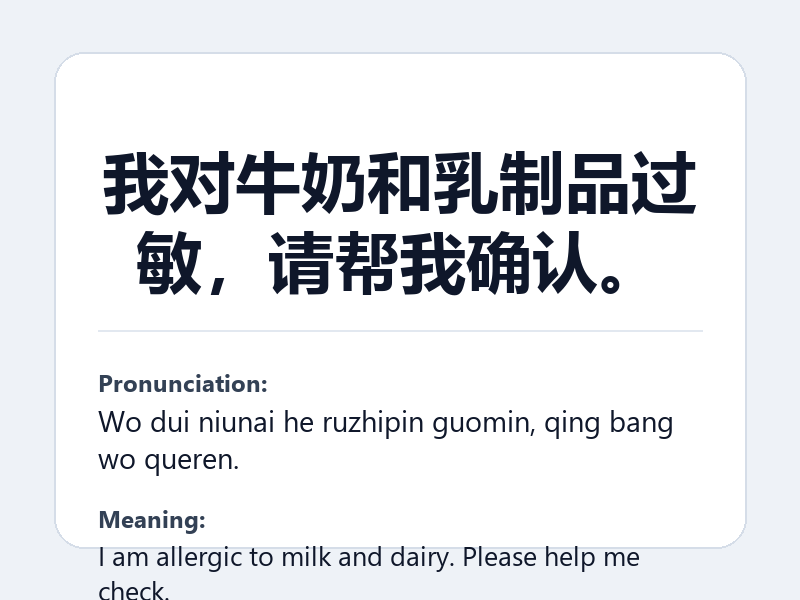
Save this phrase card before you go out. - 我对牛奶和乳制品过敏,请帮我确认。 (Wo dui niunai he ruzhipin guomin, qing bang wo queren.)
I am allergic to milk and dairy. Please help me check.
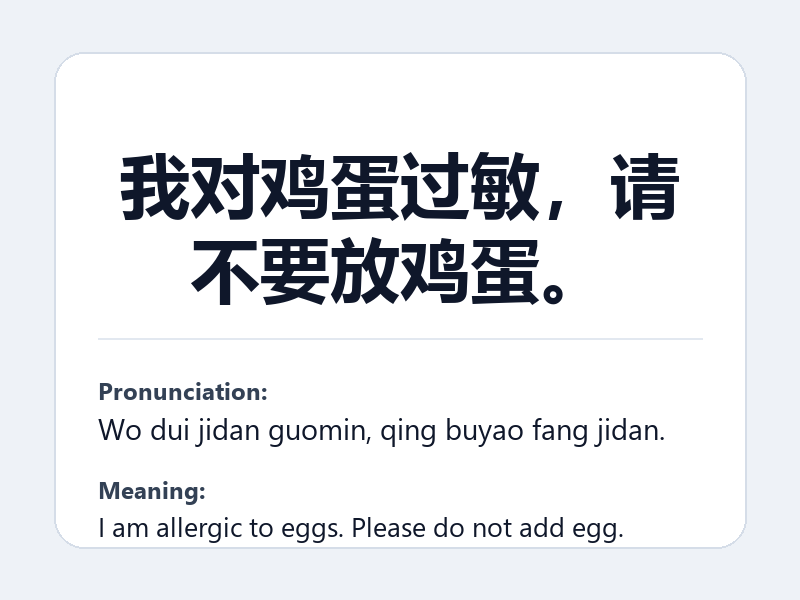
Save this phrase card before you go out. - 我对鸡蛋过敏,请不要放鸡蛋。 (Wo dui jidan guomin, qing buyao fang jidan.)
I am allergic to eggs. Please do not add egg.
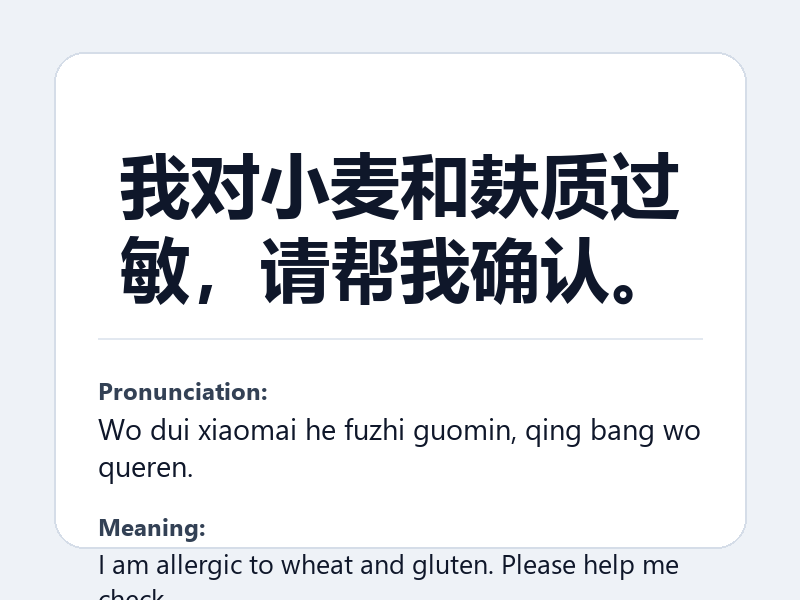
Save this phrase card before you go out. - 我对小麦和麸质过敏,请帮我确认。 (Wo dui xiaomai he fuzhi guomin, qing bang wo queren.)
I am allergic to wheat and gluten. Please help me check.
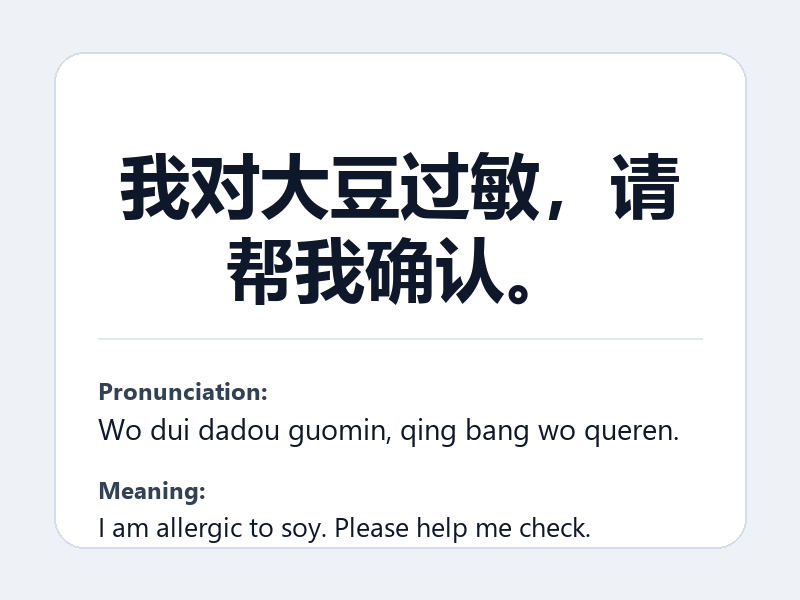
Save this phrase card before you go out. - 我对大豆过敏,请帮我确认。 (Wo dui dadou guomin, qing bang wo queren.)
I am allergic to soy. Please help me check.
Save this phrase card before you go out. - 我对芝麻过敏,请不要放芝麻。 (Wo dui zhima guomin, qing buyao fang zhima.)
I am allergic to sesame. Please do not add sesame.
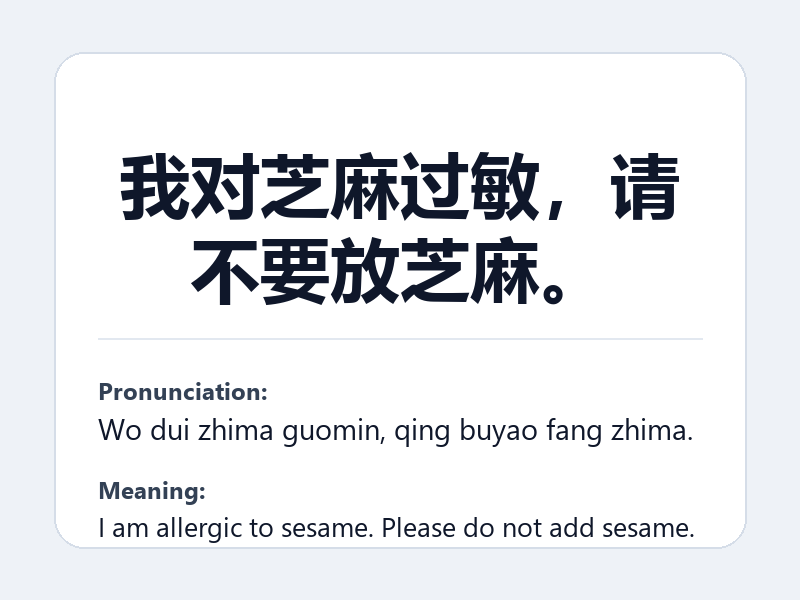
Save this phrase card before you go out.
Common allergens: English and Chinese list
The U.S. FDA identifies nine major food allergens: milk, eggs, fish, crustacean shellfish, tree nuts, peanuts, wheat, soybeans, and sesame. For China travel, it helps to also know the everyday Chinese words that appear on menus and ingredient lists.
| English | Chinese | Pinyin | Where it can hide |
|---|---|---|---|
| Peanuts | 花生 | huasheng | Often appears in sauces, snacks, cold dishes, desserts, and cooking oil. |
| Tree nuts | 坚果 | jianguo | A broad word. Also learn the specific nut if your allergy is severe. |
| Walnut | 核桃 | hetao | Common in snacks and desserts. |
| Cashew | 腰果 | yaoguo | May appear in stir-fries and desserts. |
| Almond | 杏仁 | xingren | Can appear in desserts, drinks, and bakery items. |
| Sesame | 芝麻 | zhima | Common in sauces, hotpot dips, noodles, buns, and desserts. |
| Milk | 牛奶 | niunai | Drinks, desserts, bakery items, creamy dishes. |
| Dairy products | 乳制品 | ruzhipin | Broad phrase for dairy; useful when milk, cream, cheese, or butter matter. |
| Egg | 鸡蛋 | jidan | Fried rice, noodles, dumplings, bakery items, sauces. |
| Soybean / soy | 大豆 / 黄豆 | dadou / huangdou | Soy sauce, tofu, bean products, many processed sauces. |
| Soy sauce | 酱油 | jiangyou | Very common seasoning; may contain soy and wheat. |
| Wheat | 小麦 | xiaomai | Noodles, dumplings, buns, pancakes, soy sauce. |
| Gluten | 麸质 | fuzhi | Less familiar to some restaurants; also show 小麦 if relevant. |
| Fish | 鱼 | yu | Fish dishes, soups, sauces, hotpot broths. |
| Shrimp | 虾 | xia | Stir-fries, dumplings, soups, sauces. |
| Crab | 蟹 / 螃蟹 | xie / pangxie | Seafood restaurants, crab roe sauces. |
| Shellfish | 贝类 | beilei | Clams, mussels, scallops; use with 海鲜 if needed. |
| Seafood | 海鲜 | haixian | Broad word. Useful if you avoid fish, shrimp, crab, and shellfish. |
| Pork | 猪肉 | zhurou | Not a major allergen for most people, but important for religious/diet restrictions. |
| Lard / animal fat | 猪油 / 动物油 | zhuyou / dongwuyou | Can be hidden in noodles, vegetables, pastries, and rice dishes. |
Where allergens can hide in Chinese food
- Peanuts and sesame: cold dishes, sauces, noodles, snacks, desserts, hotpot dipping sauces.
- Soy and wheat: soy sauce, dark sauce, noodles, dumplings, buns, pancakes, many processed sauces.
- Shellfish: seafood sauces, shrimp paste, dried shrimp, soup bases, hotpot broths.
- Egg: fried rice, noodles, dumplings, pancakes, bakery items, some sauces.
- Milk/dairy: desserts, milk tea, bakery items, cheese dishes, creamy sauces.
- Fish: fish sauce, soup stock, hotpot broth, regional sauces.
How to talk to staff
- Show the card before ordering. Point to the Chinese sentence and the allergen name.
- Ask them to confirm with the kitchen. The waiter may not know every sauce or stock ingredient.
- Choose a dish with fewer ingredients. This makes confirmation easier.
- Avoid shared fried foods if cross-contact matters. A fryer may be used for many ingredients.
- If the answer is vague, do not eat it. “Probably fine” is not enough for a serious allergy.
Severe allergy rule: if a small amount can cause a serious reaction, avoid street stalls, buffets, hotpot condiment bars, unclear sauces, and very busy restaurants where staff cannot carefully check ingredients.
What if something goes wrong?
- Use your prescribed medicine according to your doctor’s instructions. Keep it where you can reach it quickly.
- Call emergency help if needed. In mainland China, medical emergency number is 120.
- Show your allergy card and the food you ate. This can help hotel staff, restaurant staff, or medical staff understand faster.
- Ask your hotel front desk to help translate. If you are near the hotel, they may be the fastest human backup.
FAQ
Can I trust machine translation for allergies?
Use it as support, not as your only safety layer. Prepare a clear allergy card in Chinese before eating out, especially for severe allergies.
Do Chinese restaurants understand “gluten-free”?
Not always. 麸质 (fuzhi) may not be familiar to every restaurant. Show 小麦 (wheat), 酱油 (soy sauce), 面 (noodles), 饺子 (dumplings), and other concrete sources if relevant.
Should I mention cross-contact?
If cross-contact matters, yes. But many small restaurants may not be able to guarantee it. Choose a safer restaurant instead of asking a busy kitchen to solve a complex allergy problem.
Can I use the blank card for any allergen?
Yes, but fill in the allergen in Chinese if possible. English alone may not be understood in a small restaurant.