A host placing food in your bowl is often trying to look after you. It can mean “please try the good dish” or “I want you to feel welcome,” not “you must finish everything.” You can appreciate the intention and still set a clear boundary.
Start with the reason that matters
- If you are simply full, say so before your bowl is refilled.
- If you do not eat an ingredient, name it clearly.
- If you have an allergy, do not treat the situation as etiquette; stop the serving utensil and explain the medical risk.
- If you are vegetarian, confirm whether stock, lard or meat pieces are included.
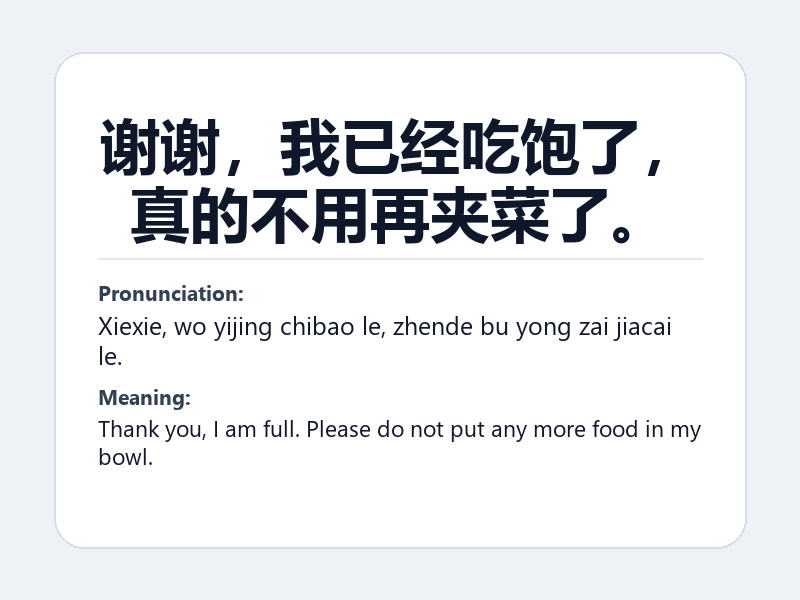
谢谢,我已经吃饱了,真的不用再夹菜了。
Pronunciation: Xiexie, wo yijing chibao le, zhende bu yong zai jiacai le.
Thank you, I am full. Please do not put any more food in my bowl.
Make the boundary easy to understand
Smile, cover the bowl lightly with your hand without touching anyone, and repeat one sentence. A long apology can sound negotiable. “Thank you, it is delicious, but I am full” is warmer and clearer than silently leaving every new piece untouched.
If you want to taste only a little
Ask for a small portion and try it at your own pace. You do not need to match every toast or finish every dish. Leaving a modest amount is not automatically an insult, though wasting a large quantity is best avoided.
When the host is older
Repeated encouragement can be part of caring for a guest. Do not interpret the first offer as pressure, but do not wait until you feel ill to refuse. Thank them and redirect attention: compliment a dish, ask about its name, or offer food to others using the serving utensils.
FAQ
Should I eat food I dislike to be polite?
You may try a safe item if you choose, but politeness does not require ignoring a medical, religious or personal boundary.
Can I move food to a side plate?
Yes, but explaining early is kinder than allowing the host to keep adding more.
What if someone uses their own chopsticks to serve me?
This can happen in informal meals. If hygiene matters to you, ask for serving chopsticks or serve yourself before the next round.
For medical restrictions, keep the cards from the food-allergy guide.